Plenty of businesses in the US, UK and Australia look to hire a web developer in India because they want skilled people, clear English, and a published price they can plan around — not because they want the cheapest possible build. That distinction matters. A good engagement looks like any other professional project: a written scope, regular conversation, and a site you actually own at the end. A poor one looks like a disappearing inbox and a half-finished theme.
This guide is for small-business owners who are comparing Indian freelancers and studios, including founder-led teams. It is a checklist of what to examine before you pay a deposit, written without the usual hype about "cheap offshore development" and without pretending that location alone guarantees quality.
Decide what you are hiring for
Write a short brief before you look at profiles. Include:
- The type of site or app (brochure site, store, booking system, redesign, or something custom)
- The pages or features you need in version one
- Examples you like, and what you like about them
- Whose job the words and photos will be
- Tools it must connect to, such as payments, email or a CRM
- A realistic date, and who on your side will answer questions
Send the same brief to everyone you talk to. Otherwise you will compare a landing-page quote with a custom-app quote and draw the wrong conclusion. If you are still sizing the project, our notes on landing pages versus a full website and small business website cost can help you set the scope first.
Studio, freelancer or large agency
Each model can work. The risks are different.
A solo freelancer may be excellent and close to the work, but holidays, illness and other clients can stall a project if there is no deputy. A large agency may have process and spare capacity, with more overhead and more hand-offs. A small studio sits in between: you usually know who is designing and building, and there is still some cover if one person is away.
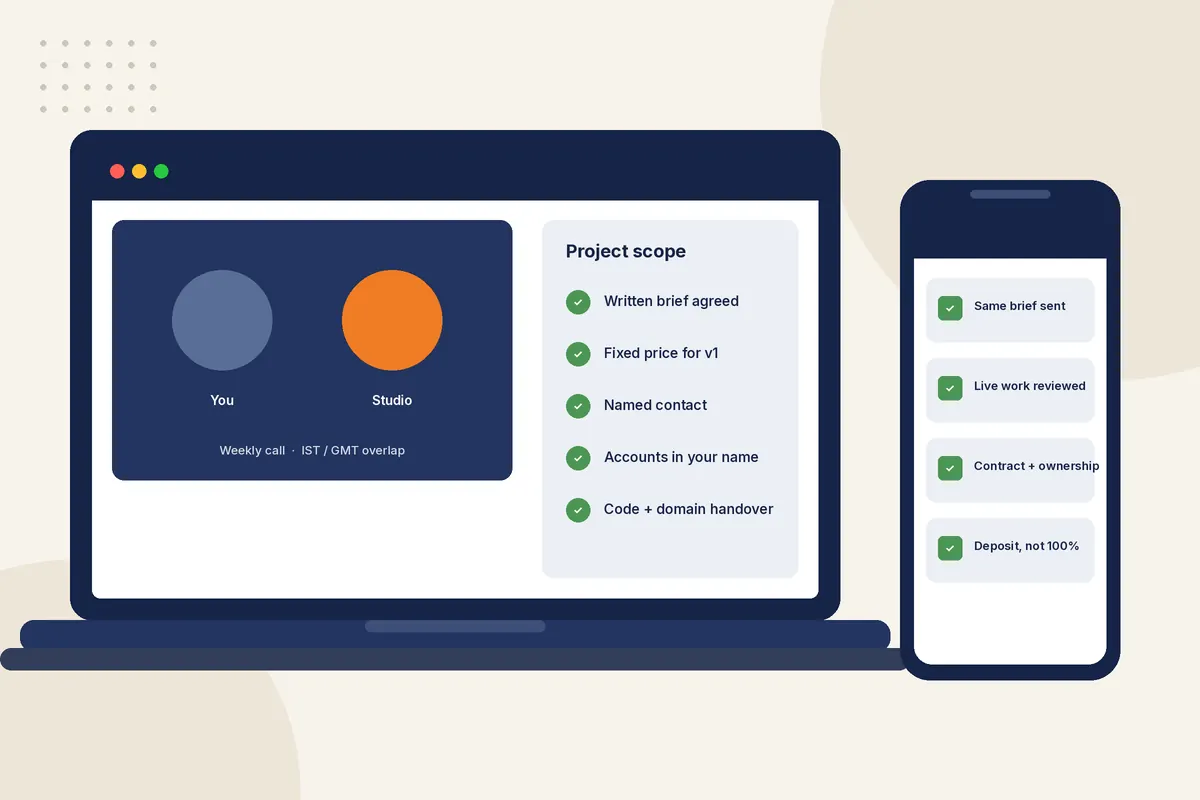
Ask who will do the work, who you will speak to each week, and what happens if that person is unavailable. A named counterpart is more useful than a generic account manager who has to relay every question.
The Webinest is a founder-led studio in Lucknow, India, and we work in the open about that. Location is part of the story, not a substitute for a clear process. You can read more about how we work on our about and web development pages.
Communication, language and time zones
English fluency varies, as it does everywhere. You should be able to judge it in the first calls. If explaining the brief already feels strained, it will not get easier when you are commenting on a design.
Agree the working language, the channel (email, a shared board, a weekly video call), and the hours when you expect a reply. India Standard Time is five and a half hours ahead of the UK, and usefully overlapped with mornings in the UK and with Australian afternoons and evenings. US overlap is shorter, but a studio that starts early or ends late can still keep a weekly live call. What matters is a rhythm you both keep, not a promise of 24-hour availability that nobody can honour.
Ask for written summaries after decisions: which pages changed, what is waiting on you, and the next date. Projects drift when everything lives in a chat thread and nobody owns the list.
Process, scope and money
A serious developer will want to understand the brief before locking a number. Be cautious if someone quotes a large, fixed figure from a one-line message with no questions, or if the price is dramatically below everyone else for the same scope.
Prefer a written proposal that states:
- What is in version one, and what is out
- How many design revision rounds are included
- The timeline, and what you must provide so it holds
- The payment schedule (a deposit, a milestone, a final payment on handover is common)
- Whether the price is fixed for that scope, and how extra work is agreed
Fixed-price work is often easier for a defined website. Hourly work can be fair for unclear or evolving product work, if the rate, cap and reporting are explicit. We have compared the two in fixed price versus hourly web development. The Webinest publishes starting prices for simpler sites on our pricing page; anything custom should still be quoted against your brief.
Pay by a method that leaves a record, and avoid transferring large sums in full before any work is shown. A deposit is normal. Paying 100% up front for a custom site is not.
What "ownership" must mean
At handover you should control:
- The domain registrar account
- Hosting or the platform account the site runs on
- The codebase or theme, in a repository or an export you can take elsewhere
- Design files, if they were part of the engagement
- Analytics, Search Console and any third-party keys, in accounts you own
If the site only exists inside a freelancer's personal account, you do not really own it. Ask at the start where the project will live, and have accounts created in your name (or your company's) with the developer invited as a collaborator. That also makes a future handover to another developer possible.
The contract should say that you own the deliverables once invoices are paid, and that third-party licences (fonts, stock, plugins) are listed. You do not need legal theatre; you do need this in writing.
How to judge the work, not the pitch
Look at live websites, not only slide decks. Click them on your phone. Ask which parts the person or studio actually designed and built, and be wary of a portfolio that is all concept shots or other people's products. A smaller set of real, shipped sites is more useful than a grid of mock-ups.
For a redesign, ask how they will handle existing URLs and redirects. For a store, ask how payments, tax and order emails are tested. For a marketing site, ask how you will edit ordinary pages after launch. The quality of those answers tells you more than a promise to "deliver SEO and a unique design".
References help when you can speak to a recent client, even briefly. Reviews on third-party sites are a supplement, not a substitute for looking at the work.
Red flags worth walking away from
- No questions about your business, only a package name and a discount if you start today
- No written scope, or a scope that changes in chat without an updated quote
- Unwillingness to use a contract, or to say who owns the code and accounts
- Stock "our team" photos, invented awards, or testimonials you cannot trace
- Pressure to pay in full, or to move the conversation off the original platform in a way that leaves you with no record
- A sample site that is slow, broken on mobile, or clearly a default theme with the logo swapped
None of these is unique to India, and none of them is typical of a careful studio. They are simply expensive to ignore.
A simple way to run the first project
Start with a contained first phase: a defined website, a deposit, a design review, a staging link you can click, and a handover checklist. Meet weekly, even for fifteen minutes. Give feedback in batches, not in dozens of one-line messages. When the site goes live, confirm that you have the logins, that forms arrive, and that the support window is dated and clear.
If that first project goes well, a longer relationship is easy to extend. If it does not, you still own a working site rather than a messy half-build.
Quick checklist
- Have you sent the same written brief to every developer you are comparing?
- Do you know who will do the work and when you can speak to them each week?
- Is the quote fixed against a scope, with extras handled in writing?
- Will accounts, code and the domain sit in your name from the start?
- Have you clicked live work on a phone, and asked how handover and support work?
Frequently asked questions
Is it a good idea to hire a web developer in India for a small business site?
It can be, when the brief is clear, communication is easy, and ownership of the site is settled in writing. Treat it as you would any remote hire: judge the work, the process and the contract, not the country on its own. Time zones and payment methods are practical details to agree early, not after a delay appears.
How do I compare prices fairly?
Compare the same sitemap and the same list of features, including content, revisions, launch setup and support. A low figure that leaves those out is not a saving. Published starting prices are a useful floor for simple sites; custom work should still be quoted in detail.
What should I own at the end of the project?
The domain, the hosting or platform account, the code or export, and the analytics or advertising accounts, all in your name. The developer can remain a collaborator for support, but they should not be the only person who can log in.
Want to talk through a brief?
Hiring a web developer in India should feel like hiring a professional studio: a clear scope, a named person to speak to, and a site you hold the keys to. The Webinest works with small businesses in the US, UK, Australia and elsewhere from Lucknow, on fixed-price websites and web apps. If you have a brief and you would like an honest view of the scope, get in touch with our team.