For a contractor, a website earns its keep when it produces jobs: a phone call, a form with a photo attached, a message you can actually quote from. Contractor website lead generation is not about collecting newsletter sign-ups or chasing vanity traffic. It is about a homeowner or facilities manager, often on a phone, deciding that you look like the firm to call this afternoon.
This guide is for trade businesses — roofing, building, remodeling, electrical, HVAC, landscaping and similar work — in the US, UK and Australia, whether you run one crew or several. It focuses on what the site must do to turn a visit into an enquiry, and on the content that supports local search without sounding like a brochure written for another industry.
What a useful lead looks like
Not every form submission is equal. A strong enquiry tells you the job type, the location, a way to get back in touch, and enough detail to decide whether a visit is worthwhile. A blank "contact us" box that says "need work done, call me" is weaker than a short form that asks for the service, the suburb or postcode, a preferred time, and an optional photo.
Decide which actions you want to count:
- Tap-to-call, especially for emergency or storm work
- A quote or estimate form that arrives in a shared inbox
- A booking request for an inspection or measure
- A message on a channel you genuinely monitor, with the website still holding the facts
If the only path is a Facebook message, you will lose people who do not use Facebook, and you will lose messages when one person is on site. The website should be able to take the lead even if social media is part of how you market.
The first screen on a phone does most of the work
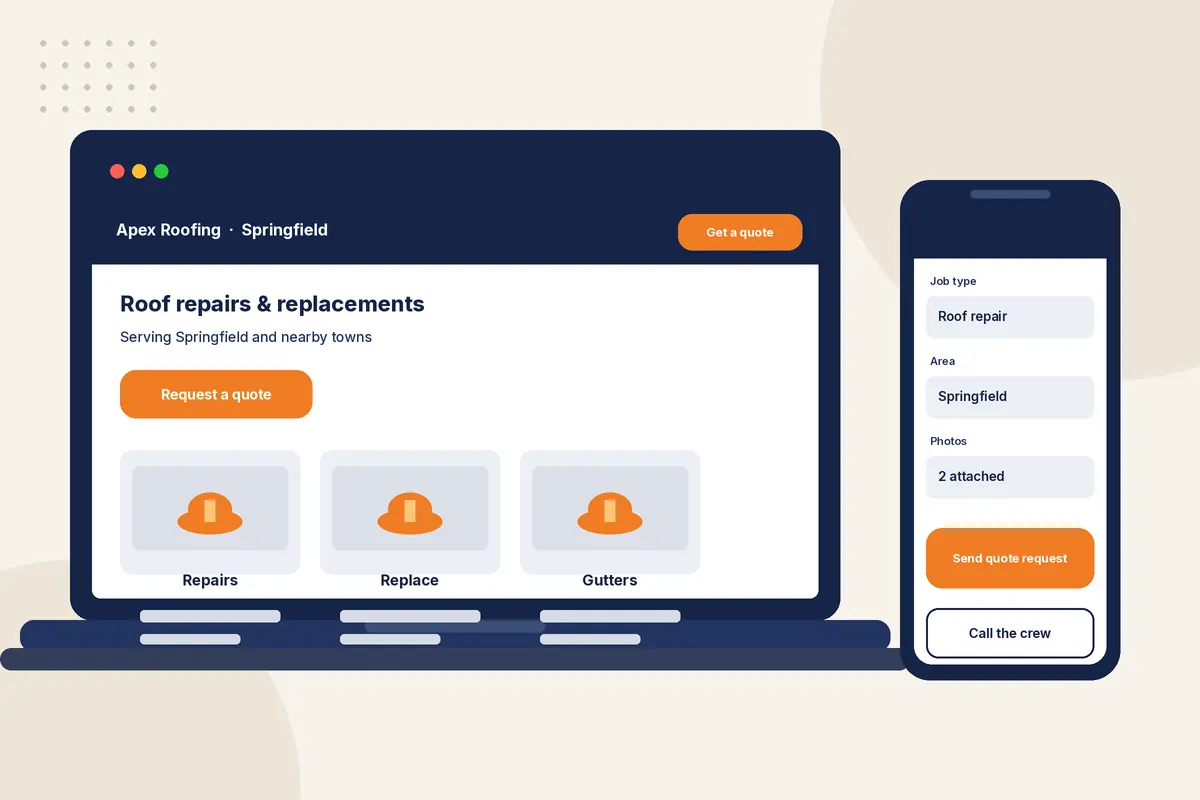
Most visitors will never scroll a long brand story. In the first few seconds they want to know that you do their kind of job, that you serve their area, and how to ask for a quote. Put that above the fold:
- A plain headline: the trade, the area, the job types you want ("Roof repairs and replacements in [town]", not "Quality craftsmanship since 1998")
- One primary action, worded the same way in the header and on the first screen: "Get a quote", "Call now", or "Book an inspection"
- A phone number that is tappable, and a form that does not start with ten required fields
- A trust cue you can stand behind: years trading, licence or insurance wording you already use, or a short line of real reviews
Template sites aimed at restaurants or gyms, leftover slogans, and stock photos of people in unused hard hats all slow that decision down. Homeowners compare two or three tabs. The clearer site usually gets the call, even if the other firm has a flashier animation.
Service pages and area pages generate the search traffic
A single homepage cannot rank for every job you do in every suburb, and it cannot explain the work well enough for someone who searched a specific term. Contractor website lead generation gets easier when you have:
- A page for each service you actually want to sell, written in customer language (repair versus replace, install versus service, commercial versus domestic where that matters)
- A clear list of towns or regions you cover, and, where it is genuine, a short page or section for the areas that already send you work
- Internal links between those pages and the homepage, so neither is an island
Do not invent coverage you cannot serve, and do not clone the same paragraph across twenty suburb pages. A short, honest area page with local proof — a recent job, a landmark, travel or access notes — is more useful than thin location spam, and safer.
Roofing firms can see this structure in more detail in our roofing website design guide and on the roofing industry page; the same pattern holds for most trades.
Build a quote path an estimator will use
The form is the conversion engine. Keep it short, but ask for what your team needs:
- Job type (a list is better than a free-text blank)
- Location
- Name, phone and email
- A place to describe the problem
- Photo uploads for roofs, damage, fuse boards, or outdoor spaces, if you quote from pictures
Send submissions to a shared inbox or job board that more than one person can see, and reply with a human note on what happens next. A form that disappears into a personal email nobody checks will train you to think "the website does not work" when the process is the problem.
If you run ads, the landing page should match the promise in the ad and use the same quote path. A general homepage with a buried form wastes paid clicks. Landing pages exist for that job.
Proof has to be specific and true
Contractors win on trust as much as on price. The site should show:
- Before-and-after photos of your jobs, compressed so they load on a phone, with alt text that describes the work rather than "IMG_4021"
- Reviews you actually received, attributed honestly, or an embed from a profile you own
- Licence, insurance or warranty wording you already use in paperwork, not invented awards
- A real about section: who turns up, who answers the phone, how long you have traded
Do not publish star ratings you cannot back up, or stock attic photos that do not match your climate or housing stock. People notice, and so do competitors.
Speed, hours and follow-up
A heavy slideshow on the homepage can cost you the lead before the form appears. Compress images, avoid auto-playing video in the hero, and check the page on a mid-range phone over mobile data. Google's Core Web Vitals guidance is a useful benchmark for whether the main content appears quickly enough.
Also state the basics that reduce back-and-forth: hours, the area you cover, whether you offer emergency call-outs, and how soon someone replies to a quote request. Then keep that promise. A site that says "we respond within one business day" and goes quiet for a week hands the job to the firm that rang back.
After the enquiry arrives, speed still matters. A short, professional reply with the next step — a time window for a visit, or a request for one more photo — closes more work than a polished website and a slow callback.
Local search is a content job, not a trick
Most contractor leads from search start with a trade plus a place, or a problem plus a place ("leaking roof [town]", "emergency electrician near me"). The site helps when:
- Page titles and headings use the words customers use, including the town or region where it is natural
- Name, phone, address or service area, and website are consistent on the site and on your Google Business Profile and other listings
- You publish the odd piece of useful guidance only when you can stand behind it, rather than filling a blog with generic "ten tips" nobody asked for
Paid search can fill gaps while organic results build, but the landing experience still has to follow the rules above. If you are running ads onto a slow or vague site, fix the site first.
When the current site is the reason leads stall
If volunteers or office staff cannot update photos, if the quote button goes nowhere, or if the design is clearly a template for another industry, a tidy-up may not be enough. Our website redesign work for trades starts with the enquiry path and the service structure, not with a new colour palette alone. For a wider view of when a rebuild is justified, see signs your website needs a redesign.
Quick checklist
- Can a new visitor see your trade, area and a quote or call action in a few seconds on a phone?
- Is there a service page for each job you actually want?
- Does the form collect the details an estimator needs, including photos where useful?
- Do enquiries arrive in a shared inbox that someone answers promptly?
- Are photos, reviews and credentials real and compressed for mobile?
- Do titles and listings use the same business name and service area?
Frequently asked questions
What should a contractor website include to generate leads?
At minimum: a clear homepage, a page for each main service, a service-area explanation, real job photos, a simple quote or call path, and contact details that work on a phone. Add FAQs, financing notes or emergency call-out information only if they are true and you can keep them current.
Is Google Business Profile enough without a website?
A complete profile is essential, and it will win some calls on its own. A website still earns its place as the page that explains services, shows a wider gallery, hosts a proper quote form, and gives ads or search results a destination you control. They work better together than either does alone.
How quickly should we respond to website enquiries?
As fast as you reasonably can, and in line with whatever the site promises. For many trades, a reply the same day — even if it is only to book a visit — is enough to stay in the running. Saying nothing for several days usually means the homeowner has already booked someone else.
Want a contractor website that asks for the job?
Good contractor website lead generation is mostly clarity: the right pages, an honest enquiry form, proof you can stand behind, and a site that works on a phone. The Webinest builds fixed-price websites for trades and other local service businesses, with the quote path and service structure treated as part of the design. If you would like a straightforward look at your current site, get in touch with our team.