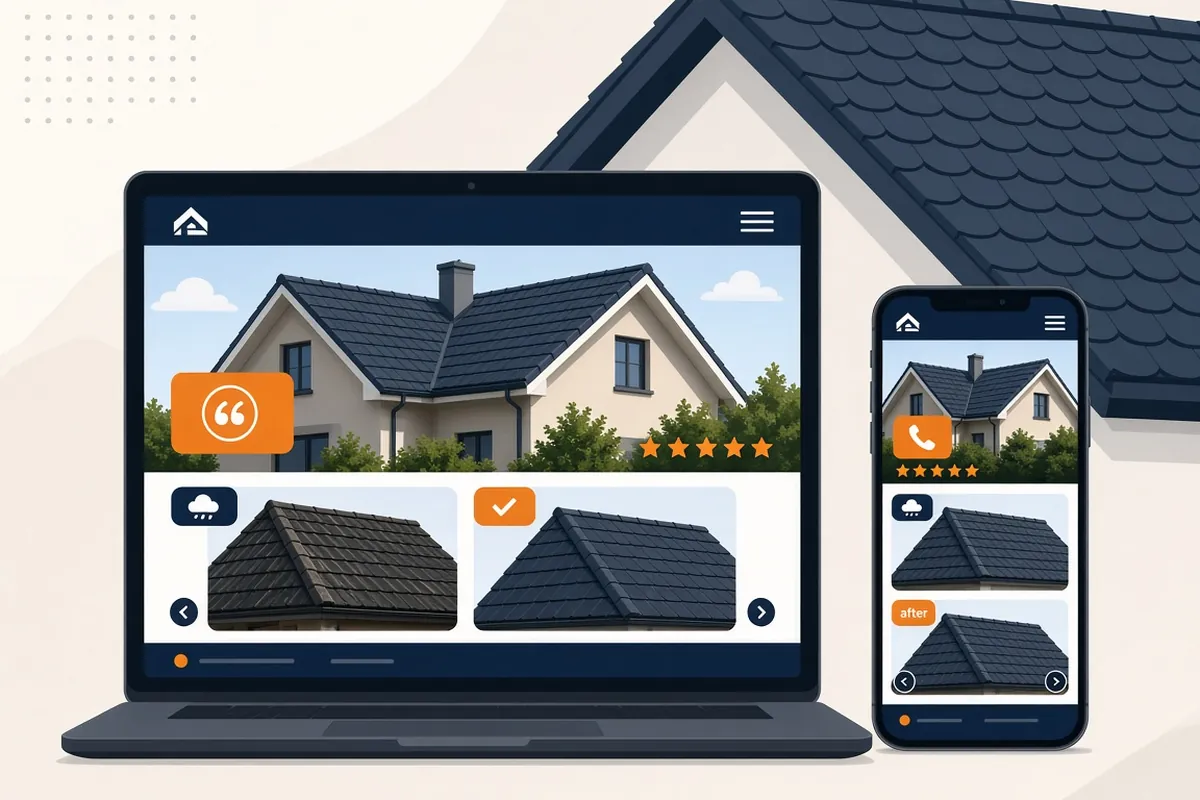
A homeowner with a leak, a slipped tile or an ageing roof rarely calls the first roofer they find. They open three or four websites on their phone, compare them for a minute or two, and ring the one that feels safest. Your roofing website design decides whether you make that shortlist.
This guide is written from the other side of the screen: what a homeowner looks for, in roughly the order they look for it, and what your site needs to show at each step. Use it as a checklist for a new build or a review of your current site.
Why roofing websites are different
Roofing is a high-trust, high-cost purchase that people make rarely and often under pressure. Someone with water coming through the ceiling wants a fast answer. Someone planning a full replacement wants reassurance that they won't be overcharged or left with a half-finished job. Both are nervous about letting a stranger onto their roof.
That means a roofing website has three jobs, in this order:
- Confirm relevance in seconds. Do you do the work they need, in the area where they live?
- Remove doubt. Are you a real, established, insured business that does good work?
- Make contact effortless. Can they call, or request a quote, without hunting for the button?
A beautiful site that fails any one of these loses the job to a plainer competitor that gets them right.
What homeowners check first (the first screen)
Most of your visitors will arrive on a phone, often from a map listing or a local search. Whatever they see before scrolling has to answer the first question immediately.
A plain headline with service and area
"Roof repairs and replacements across Leeds and West Yorkshire" beats "Quality you can trust" every time. Name the services you want calls for and the towns or counties you cover. If you handle emergency work, say so here.
A phone number they can tap
Put your number in the header of every page as a tap-to-call link, and keep it visible as people scroll on mobile. Many roofing enquiries are urgent, and urgent customers phone rather than fill in forms.
One clear next step
Pick a single primary action, such as "Book a free roof inspection" or "Get a quote", and use the same wording on every page. Three competing buttons ("Call", "Email", "Chat", "Download our brochure") create hesitation.
A real photo of your work
A stock image of a smiling model on a ladder tells the visitor nothing. A photo of one of your own finished roofs, your van or your crew on site tells them you exist and you're local.
Trust signals that turn a visit into a call
Once a homeowner knows you do the right work in the right place, they start looking for reasons to trust you, or reasons not to. Put the evidence near your calls to action, not buried on an About page.
- Before-and-after photos. These are the most persuasive content a roofer has. Label them with the job type and the town, for example "Slate re-roof, Harrogate".
- Genuine reviews. Show real reviews from your Google Business Profile or an independent review platform, and link to the source so people can check them. Never write or buy reviews; in the UK the Competition and Markets Authority has published guidance on fake and misleading reviews, and similar rules apply in the US and Australia.
- Accreditations you really hold. Trade association memberships, manufacturer approvals, licences where your state or region requires them, and your insurance. Only use badges you're entitled to; a homeowner who checks one false claim will doubt everything else.
- Warranty in plain words. Explain what your workmanship guarantee covers and for how long, and how it differs from the manufacturer's materials warranty.
- Who they'll deal with. A short paragraph about the business, how long you've worked the area and a team photo makes you feel less like a stranger.
The pages a roofing website actually needs
You don't need fifty pages. You need the right ones, each answering a specific question and each ending with the same call to action.
One page per core service
Roof repairs, full replacements, flat roofs, chimney and leadwork, gutters and fascias, or whatever you actually sell. Separate pages let you answer service-specific questions (how long a flat roof lasts, whether a repair or a replacement makes more sense) and give search engines a clear page to show for each search.
Area pages with real local detail
If you cover several towns, a page for each main area can help you appear in local searches. Make them genuinely different: local projects, typical roof types in that area and photos from jobs there. Copying the same text and swapping the town name is easy to spot and adds little.
Emergency and storm damage
If you do emergency call-outs, give them their own page that explains what you can do quickly (making a roof watertight, temporary covers) and how fast you usually respond. State response times you can actually keep.
Insurance claims and pricing questions
Homeowners want to know what drives the cost: roof size and pitch, materials, access and scaffolding, and whether old coverings need stripping. You don't have to publish a price list, but explaining the factors builds trust. If you help with insurance claims, explain your part in the process without promising that a claim will be paid.
Projects, about and contact
A gallery of recent jobs filtered by roof type or area, a short About page and a contact page with your phone number, a short form, your service area and opening hours complete the core set.
Quote forms that people finish
Every extra field is a reason to give up. For a first contact you usually only need a name, phone number, postcode or ZIP code and a short description of the problem. An optional photo upload is useful for roofers, because a picture of the damage helps you prioritise and prepare.
After someone submits the form, show a confirmation that says exactly what happens next ("We'll call you today to arrange a visit") and send the same message by email or text. Then make sure the enquiry lands somewhere that someone checks during working hours. A fast reply often wins the job.
If you run paid ads for a single offer, such as free roof inspections, a focused landing page with one form and one message usually works better than sending that traffic to your homepage.
Local SEO basics built into the design
A roofing website that nobody finds can't generate calls. Most roofing searches are local, so a few technical foundations matter more than clever copy.
- Consistent business details. Your business name, address or service area, and phone number should appear as text on the site and match your Google Business Profile exactly. Google's guidelines for representing your business explain what is and isn't allowed.
- Structured data. Schema markup helps search engines understand your business. Schema.org includes a specific RoofingContractor type, and Google documents how it reads local business structured data.
- One clear page per search. Each service and area page should have its own title, one H1 and a description that matches what people type, so your pages don't compete with each other.
- Internal links in sentences. Link from service pages to related projects and area pages, and back again, using descriptive wording rather than "click here".
Speed and mobile performance
Roofing sites are often slowed down by the very things meant to impress: autoplay video headers, large image sliders and uncompressed project photos straight from a phone camera. Compress and resize photos, use modern formats such as WebP, and load gallery images lazily so the first screen appears quickly.
Test your key pages on a phone, not just a desktop, and run them through Google's free PageSpeed Insights tool. Fix the issues it flags on your homepage, main service pages and contact page first.
Common roofing website mistakes
- A homepage slider with vague slogans and no clear service or area.
- The phone number only in the footer, or shown as an image that can't be tapped.
- Stock photos instead of your own jobs.
- Badges, ratings or review counts that can't be verified.
- A long contact form asking for budget, roof dimensions and timescales up front.
- One "Services" page listing everything, so nothing ranks well.
- The domain or hosting registered to a previous web designer instead of your business.
If several of these sound familiar, a focused website redesign is often a better investment than more advertising, because it improves the return on every visitor you already get. Our guide to the cost of redesigning a small business website explains what affects the budget.
A quick self-check for your current site
Open your website on your phone and answer honestly:
- Within five seconds, can a stranger tell what you do and where?
- Can they call you with one tap from any page?
- Do they see your own work and genuine reviews before they scroll far?
- Does each main service have its own page?
- Can the quote form be completed in under a minute?
- Does the site load quickly on mobile data?
- Do you own the domain, hosting and site files?
Every "no" is a place where you're probably losing enquiries to a competitor.
Frequently asked questions
How many pages does a roofing website need?
A solid starting point is a homepage, one page per core service, a projects gallery, an about page and a contact page. Add area pages and an emergency or storm damage page if they match how you work. Quality and clarity matter more than page count.
Should a roofer show prices on their website?
You don't need a fixed price list, as every roof is different. Explaining what affects the price, and offering a free inspection or quote, answers the question honestly without committing to numbers you can't stand behind.
Is a template good enough for a roofing company?
A well-built template can work for a small operator starting out. As you grow, a custom website makes it easier to add service and area pages, quote forms with photo uploads and faster performance without fighting the theme.
Ready to get more calls from your website?
The Webinest builds fast, mobile-first websites for trades and local service businesses, with clear calls to action, quote forms and local SEO foundations in place from day one. If you'd like an honest review of your current roofing website, or a quote for a new one, get in touch with our team.