Nobody hires an interior designer on a whim. Before someone trusts a studio with their home, their budget and several months of decisions, they look closely. They open a few interior design websites, scroll through the work, try to work out how each studio operates, and then quietly decide which one feels like the safest pair of hands. That quiet decision is where interior design website design either earns the enquiry or loses it to a studio with clearer projects and a simpler next step.
This guide is for interior designers, stylists and small studios who already have a website, often on Squarespace, Wix or a WordPress theme, and want it to bring in more of the right enquiries. It follows the questions real clients ask themselves as they move through your site.
The five questions clients are silently asking
Whether someone searched "interior designer near me", "kitchen designer [town]" or found you on Instagram, they usually want answers to five questions before they get in touch:
- Have you done work like mine? A similar home, budget, style or type of space.
- What exactly do you offer? Full-service design, a single room, a paid consultation, e-design, sourcing or project management.
- What is working with you like? The stages, how long it takes and how involved they need to be.
- How do you charge? Not necessarily a price list, but an honest idea of how fees work.
- How do I start? One clear, low-pressure first step.
Most underperforming designer websites answer the first question beautifully with a gallery and then go quiet on the other four.
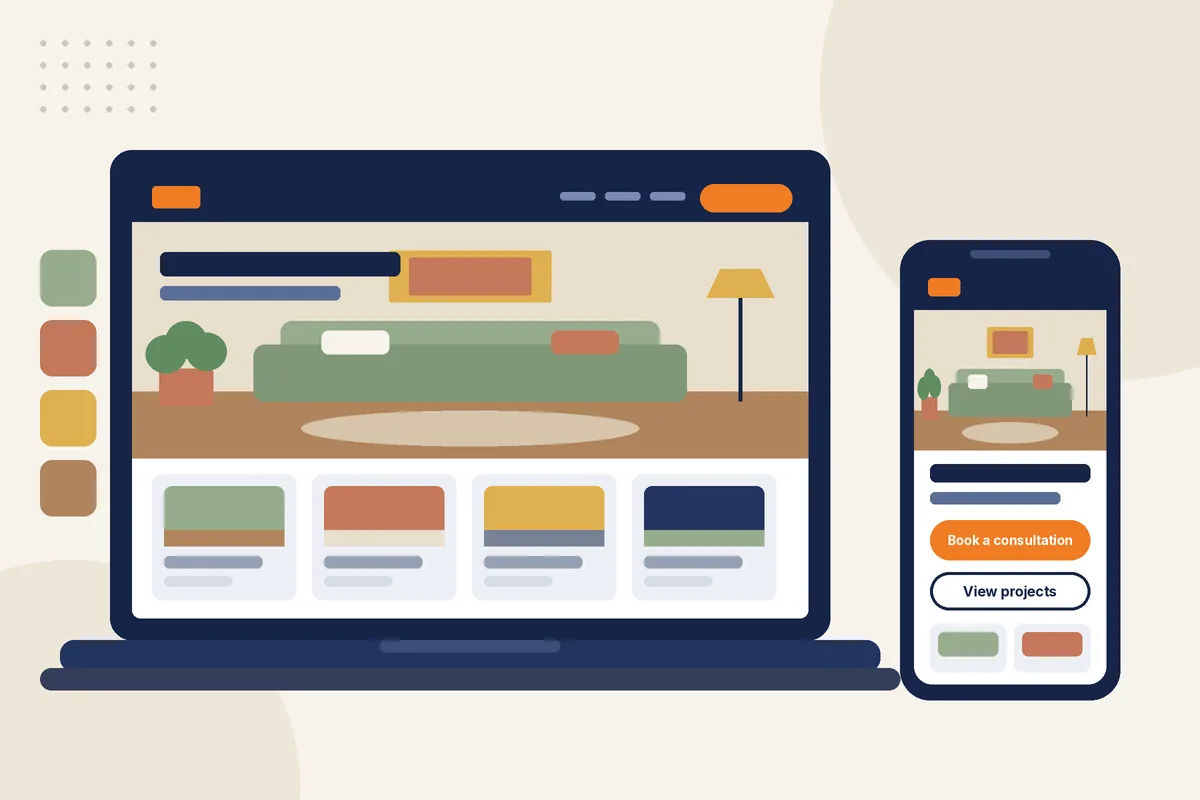
A homepage that shows taste and gives direction
Your homepage has two jobs: prove your eye and point people somewhere useful. A simple order works well:
- A headline that says what you do and where. "Residential interior design for period homes in Bath" beats "Spaces that inspire". It helps visitors and search engines in the same sentence.
- One primary action. "Book a design consultation" or "Start a project", used with the same wording on every page.
- Three to six featured projects with a short caption each: room or property type, town and style. Each one links to its own project page.
- Services in plain language, using the words clients actually search for.
- A short process strip of three or four steps, linking to the full process page.
- Real proof, such as reviews you can show, press features or professional memberships, but only if they exist.
Be careful with full-screen sliders. Five rotating images with five different headlines look impressive in a template preview but make visitors wait, and most people never see slide three. One strong image and a clear sentence usually do more.
Portfolio pages: case studies, not just galleries
A grid of beautiful photos shows taste. A case study shows how you think, and that is what persuades someone to hand over a whole-home project. Give each featured project its own page with:
- A descriptive name, such as "Victorian terrace kitchen, Clifton", rather than the client's surname.
- The brief in two or three sentences: what the client wanted and what was getting in the way.
- Your scope: full design, layout and lighting only, furnishing and styling, or project management.
- Before and after photos from similar angles where you have them.
- Key decisions: materials, joinery, colour choices or a layout change that solved the problem.
- A link at the bottom such as "Planning something similar? Book a consultation."
Respect client privacy
Ask clients for permission before publishing their home, use the town or neighbourhood rather than a street address, and avoid photos that show house numbers, family photos or anything that identifies the property. Careful handling of privacy is itself a trust signal for the next client reading the page.
Explain your process and how you charge
The biggest worry most people bring to an interior designer is losing control of time and money. A process page answers that before the first call. Set out your stages in order, for example discovery, concept, design development, sourcing and procurement, installation and styling, and for each one say what happens, what the client needs to do and roughly how long it usually takes in your studio.
You don't have to publish prices. You do need to explain how you charge, whether that's a fixed design fee, an hourly rate, a percentage of the project or a mix, and how furniture and materials purchases are handled. If you have a minimum project size or a starting point for full-service work, saying so politely filters out enquiries that would never be a fit and saves both sides a wasted consultation. Only show figures you are happy to honour.
Replace "Contact us" with a proper enquiry form
A form that asks only for a name, email and message puts all the work on the client and tells you almost nothing. A short design enquiry form helps both sides:
- Project location (town or postcode)
- Type of property or space: house, flat, office, restaurant, holiday let
- Scope: single room, several rooms, whole home or renovation
- Services needed: full design, consultation only, styling, sourcing
- Preferred timeline
- Approximate budget band (offer ranges and make it optional)
- An optional upload for a floor plan, photos or a moodboard
Keep it to one screen on a phone if you can, and finish with a confirmation that says when you'll reply. A calendar link for a discovery call works well alongside the form for clients who prefer to talk first.
Image quality without the slow page
Interior design websites live and die by their photography, which is exactly why they are often slow. A homepage carrying a dozen full-resolution photos straight from the camera can take a long time to appear on a phone, and many visitors won't wait.
Google's Core Web Vitals guidance treats the main content appearing within 2.5 seconds as "good". You can keep the images large and beautiful and still get there:
- Resize photos to the largest size they are actually displayed at, rather than uploading 6,000-pixel originals.
- Use a modern format such as WebP and compress carefully; you rarely lose visible quality.
- Serve smaller versions to phones using responsive images.
- Lazy-load photos further down the page, but not the main image at the top.
- Give every image descriptive alt text, such as "walnut kitchen island with brass pendant lights". Google's own image SEO guidance recommends descriptive filenames and alt text, which also helps people using screen readers.
Designing for mobile browsing
A lot of portfolio browsing happens on a phone, often in the evening, in the very room someone wants to change. Check your own site on a phone and look for:
- A headline and enquiry button visible without zooming
- Project photos that aren't awkwardly cropped by a desktop-first layout
- A menu or chat widget that doesn't cover the main button
- Form fields that are easy to fill in with one thumb
- No platform banner or "made with" strip across the top
Trust signals that suit a design studio
Design buyers are cautious about deposits and long projects. These details help, as long as they are true:
- A studio or about page with real photos of you and your team, not stock images
- Where you work, and whether you take projects further afield or remotely
- Professional memberships, qualifications, awards or press coverage
- Reviews you can show, ideally linked to Google or Houzz
- Consistent details across your website, Google Business Profile, Houzz and Instagram
Avoid vague claims such as "hundreds of happy clients" that the portfolio can't back up. Careful clients compare claims to the work, and a modest, accurate page is more convincing than an inflated one.
Local SEO without keyword stuffing
Most clients look for a designer within reach, so make it easy for search engines to connect you with your area and services:
- Put your main service and town in the homepage title and first paragraph.
- Write a unique title and meta description for each page, especially project pages.
- Create service pages for the work you genuinely do, such as kitchen design, commercial interiors or home styling.
- Add location and style naturally to project page titles and text.
- Publish occasional helpful articles that answer real client questions, such as how long a design project takes.
The same principles apply to other industries. Our guide to roofing website design shows how a very different business handles trust and quote requests.
When a redesign makes sense
Sometimes better photos, faster images and a clearer form are enough. A full website redesign is worth considering when the template can't support proper project pages, the site breaks on phones, platform branding can't be removed, or galleries are too slow to fix without starting again. If you'd like to see what a focused studio site includes, our page on websites for interior designers sets it out.
Quick checklist
- Can a stranger tell what you do and where within five seconds?
- Are your best projects visible without hunting?
- Does each featured project have its own case study page?
- Is your process explained, including how you charge?
- Is there one clear enquiry action on every page?
- Does the enquiry form ask for project type, location, scope and timeline?
- Do photos load quickly on a phone signal?
- Is every claim on the site something you can back up?
Frequently asked questions
What pages does an interior design website need?
A strong starting set is a homepage, a studio or about page, services, a portfolio with individual project pages, a process page and an enquiry page. Add service and location pages as your work genuinely grows into them.
Should interior designers show prices on their website?
You don't need a full price list, but you should explain how you charge and, if you have one, mention a minimum project size or starting point. It sets expectations and reduces mismatched enquiries.
Is Squarespace or Wix good enough for an interior designer?
For a new solo studio, a well-built template site on your own domain can work. As your portfolio grows and you need detailed project pages, faster galleries and a qualifying enquiry form, a custom site removes the limits of the template.
Want more of the right enquiries?
Good interior design website design isn't about flashy animation. It's about letting your work speak and making the next step feel easy. The Webinest builds fast, image-led websites for design studios and small businesses, with clear enquiry paths and SEO foundations from day one. If you'd like an honest look at your current site, get in touch with our team.