If you are pricing a first website for a small business, the number that matters is not a single average pulled from a survey. Small business website cost depends on what you are actually buying: the pages, the design work, the content, the integrations and the care the site needs after launch. Two quotes that look far apart often describe two different jobs.
This guide is about a new build, not a rebuild of a site you already have. If you are replacing an existing site, start with our article on the cost of redesigning a small business website. Here we walk through what a first site should include, what usually drives the price up or down, and how to compare quotes without getting lost in packages.
What a new-website quote should cover
A useful quote is a list of deliverables, not a single line that says "website". For most small businesses, a complete new-build price should be clear about:
- Discovery: a short brief, sitemap and agreement on the pages you need now versus later
- Design: layout, typography and components that match your brand, not a theme with the logo swapped in
- Build: the templates and pages themselves, tested on a phone as carefully as on a desktop
- Content support: whether you are supplying all the words and photos, or the studio is helping
- Launch basics: a domain connection, SSL, a contact or enquiry form that actually arrives, analytics and a sitemap
- Handover: who can edit the site, and how
- A defined period of post-launch support, so small fixes are not a surprise invoice
If any of those are missing, the number is incomplete. A cheap homepage with no form, no mobile check and no way to change a phone number usually costs more later.
The cost drivers that actually move the number
Page count matters, but these factors usually change small business website cost more than an extra About page:
- Scope. A one-page landing site, a five-to-eight-page brochure site, an online store and a custom web app are different products. Mixing them in one comparison is how quotes become confusing.
- Design originality. Starting from a template is faster. Designing from your brand, photography and service list takes longer and usually costs more, but it also stops the site looking like three competitors who bought the same theme.
- Content. If the studio has to write service pages, source photos and chase approvals, that work belongs in the quote. "You send the content" is fine, as long as you have the time to do it.
- Integrations. Booking tools, payment providers, CRMs, inventory and membership logins all add design, testing and edge cases.
- E-commerce complexity. A handful of products with simple shipping is one job. Variants, tax rules, subscriptions or a wholesale login is another.
- Languages, regions and legal pages. Extra locales, currency or carefully written policy pages add time.
- Who does project management. A founder-led studio and a large agency price the same scope differently because the overhead is different.
Ask every supplier to price the same sitemap. If one quote includes copywriting, photo editing and a booking form and the other assumes you will handle all three, the cheaper figure is not cheaper. It is a shorter list.
Landing page, brochure site, store or app?
Matching the type of site to the job is the surest way to keep the budget honest.
A landing page is right when you have one offer, one audience and one action: book a call, request a quote, register for an event. It is usually the fastest and least expensive way to get a professional presence online. Our guide to when a landing page beats a full website can help you decide.
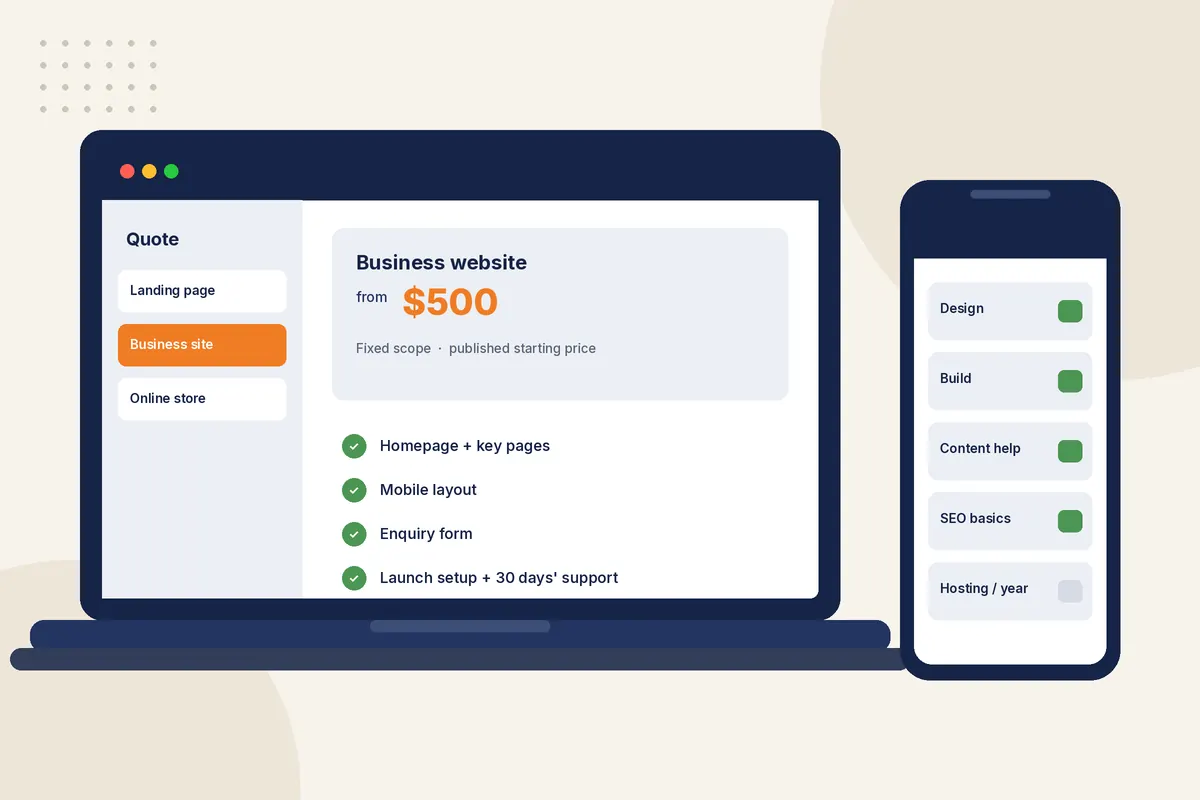
A brochure or business website is the usual first site for a local or service business: home, services, about, work or gallery, and contact, sometimes with service-area or FAQ pages. This is the shape most "small business website cost" searches are really asking about. It should be easy to update and clear on a phone.
An online store is a bigger project because products, payments, shipping and order email all have to work on day one. Budget for product entry and photography as well as the build. A custom web app should be quoted on the workflow, not on a page count.
The Webinest publishes starting prices for the simpler end of this range on our pricing page: landing pages from $250 and business websites from $500, with stores and custom apps quoted for the actual project. Those figures are starting points for a defined scope, not a promise that every industry or feature set lands at the same number.
Builders, templates and a custom build
A do-it-yourself builder can be a sensible first step if you have time, a simple story and you are comfortable learning the tool. The cash price can look low; the hidden cost is your time, and the risk of platform ads, a temporary web address, or a site that is hard to move later.
A template or theme, set up by a freelancer, sits in the middle: faster than a fully custom design, with more constraints. It works when the theme already fits the way you sell. It works less well when you have to fight the layout to explain a trade service, a studio portfolio or a booking flow.
Custom web development costs more in the quote because the structure is designed around your services and your content, not around a demo of a restaurant or a gym. For many small businesses the difference shows up in clearer enquiry paths and pages that can grow without being rebuilt twice. If you want a longer comparison, we have written about custom web development versus a template website.
There is no moral hierarchy here. The right choice is the one you can launch, maintain and afford to keep accurate.
Do not forget content, photos and SEO in the budget
Many first-site budgets only count design and code. Then the project stalls because service pages have no words, or the only photos are stretched from a phone gallery. Build time for content into the plan:
- A short, specific homepage that says who you help, where you work and what to do next
- Service pages written in the language customers use, not internal jargon
- Real photos of your work, team or premises, compressed so the site stays fast on a phone
- An about page that sounds like a real business, not a stock paragraph about "passion and excellence"
Search foundations should be in the build, not sold later as a surprise. That means sensible page titles and descriptions, headings that match the topic, image alt text, a working sitemap, and text that names your town or region if you are a local business. You do not need a six-month SEO retainer to launch well. You do need a site that Google can crawl and a person can understand.
Ongoing costs after launch
The build invoice is not the last number. A realistic running budget includes:
- The domain name, renewed each year
- Hosting or a platform subscription
- Business email on your domain, if you do not already have it
- Occasional updates: new offers, staff, photos, policy pages
- Security and software updates if you are on a self-hosted platform
- Optional retainers for support, content or SEO once the site is live
Ask what happens when the included support window ends, and what a small change costs after that.
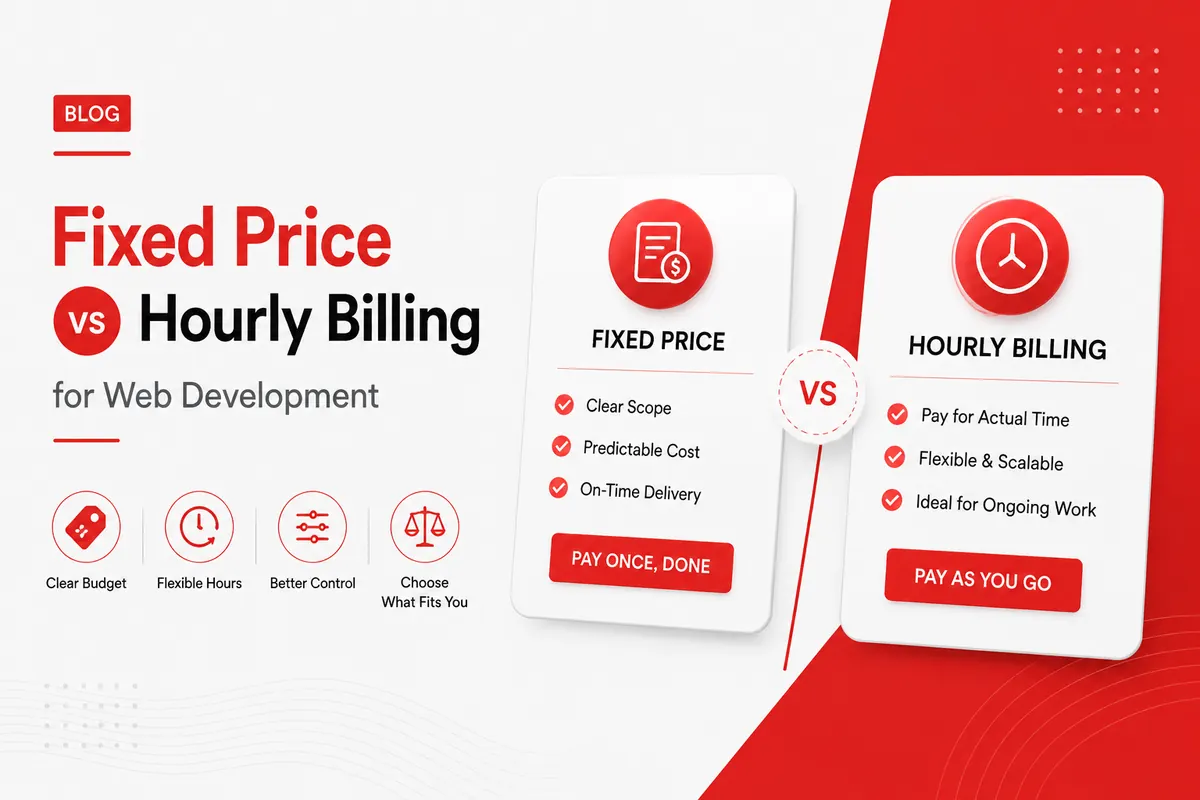
If you are choosing between a fixed project price and paying by the hour, our comparison of fixed-price versus hourly web development explains when each model is fair.
How to compare quotes without getting caught out
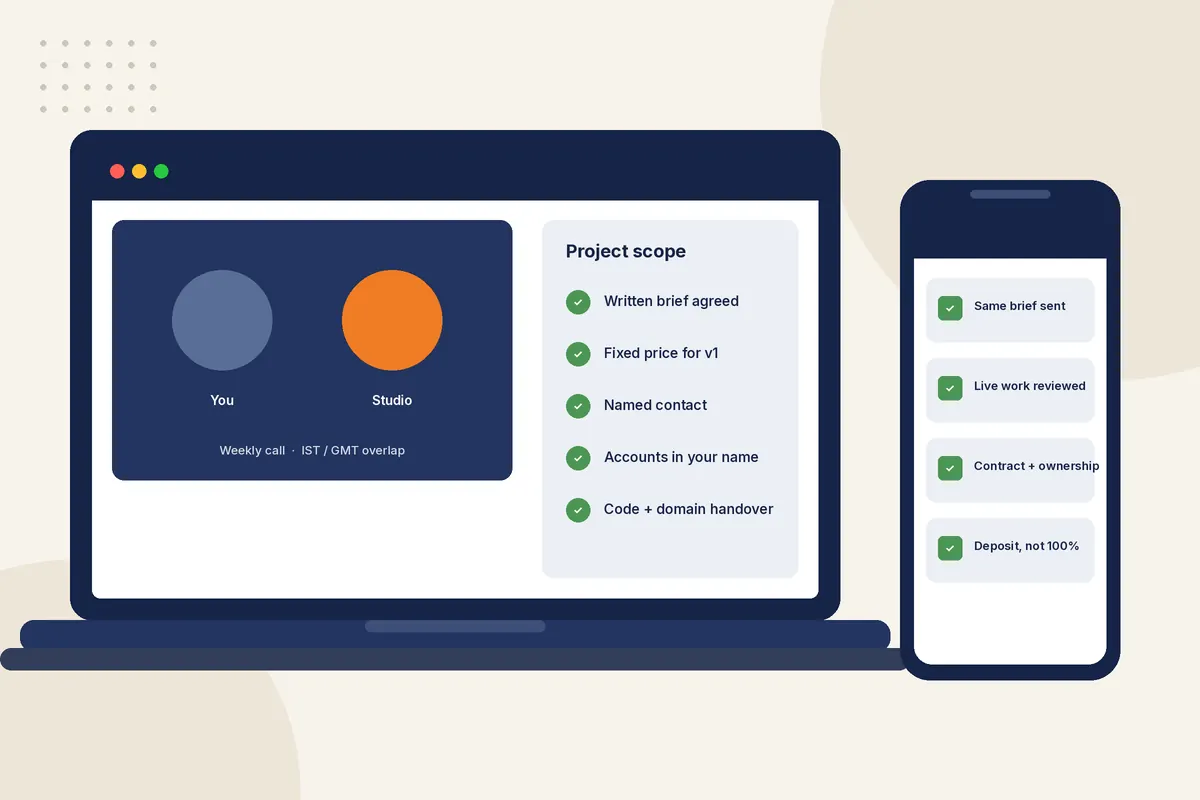
Send the same brief to everyone: the pages you want, examples you like, whose job content is, and any tools the site must connect to. Then compare:
- What is in, and what is clearly out
- How many revision rounds are included
- Who writes and uploads content
- Whether the quote is fixed for that scope, or an estimate that can move
- Who owns the design files, the code and the accounts at the end
- How you will edit the site, and who hosts it
- How long the work is expected to take, and what you need to provide so that date holds
Be wary of a price that is far below the others with no explanation, and of a high price that is mostly adjectives. A clear scope is worth more than a polished sales deck.
Quick checklist
- Have you written down the pages and the one action you want visitors to take?
- Does each quote list design, build, launch setup and support, not just "a website"?
- Is content (words and photos) assigned to you or to the studio, with time allowed for it?
- Are forms, analytics and a sitemap included?
- Do you know the first-year costs after launch, and who owns the site?
Frequently asked questions
What is a typical small business website cost for a first site?
There is no single typical figure, because a one-page landing site and a store with a hundred products are different projects. Compare quotes against the same sitemap, and treat published starting prices as a floor for a defined scope rather than a cap for every feature you might add later.
Is a cheap website builder enough to start?
It can be, if the site will be simple, you can keep it updated, and you are not blocked by platform ads or a temporary web address when you are ready to look established. If you already know you need custom service pages, a particular enquiry form or a design that matches a strong brand, a planned build is usually cleaner than fighting a template.
Should SEO be part of the website cost or a separate project?
The technical foundations — titles, headings, sitemap, usable mobile pages, sensible URLs — should be part of the build. Ongoing content and link-building work is a separate, optional engagement. Do not pay twice for the basics, and do not expect a new site to rank for competitive terms on launch day alone.
Want a clear figure for your site?
The most useful answer to "what will a small business website cost?" is a quote against a real list of pages and features. The Webinest is a founder-led studio in Lucknow, India, building fixed-price websites for small businesses in the US, UK, Australia and beyond. If you would like a straightforward view of what your first site should include, get in touch with our team.